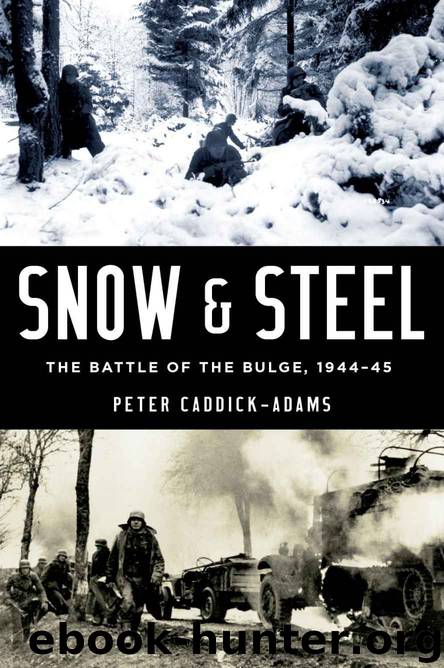
Snow and Steel: The Battle of the Bulge, 1944-45 by Peter Caddick-Adams
Author:Peter Caddick-Adams [Caddick-Adams, Peter]
Language: eng
Format: epub
ISBN: 9780199335145
Publisher: Oxford University Press
Published: 2014-10-31T00:00:00+00:00
Cota encouraged Rudder to harry the Germans as much as possible, due to his knowledge that Bastogne, now completely encircled, was about to be counter-attacked by two fresh US infantry divisions assembling in his vicinity, the Massachusetts Guardsmen of the 26th and the ‘Blue Ridge’ 80th (so-named as they comprised draftees from Virginia, West Virginia, Pennsylvania and Maryland). Rudder’s mission now became one of preventing the Volksgrenadiers from interfering with the concurrent attempts to relieve Bastogne. Guided through Ettelbrück and Grosbous by armband-wearing local resistance fighters, Rudder had Fossum’s task force dig in on high ground near Grosbous, overlooking the Ettelbrück to Arlon road from where on 22 December they were able to ambush ‘a column of men and vehicles, one-and-a-half miles long with towed artillery pieces and two tanks at its tail and no patrols for security on its flanks’.
The result was a massacre – a hackneyed phrase, but in this case accurate: with his artillery hitting the Germans’ rear first to prevent escape, Fossum’s men caused an estimated 2,000 casualties, ‘the fire was kept up for twenty minutes on everything that moved, with not one shot received in return,’ wrote Fossum, and Rudder laconically recorded, ‘We stacked them [the dead Germans] in piles along that road from Ettelbrück’.21 Fossum’s performance, which brought him a Bronze Star and Croix de Guerre, had been outstanding.22 Rudder knew his regiment’s hard training and combat experience had been rewarded, for the ambush could have been spoiled easily by a single trigger-happy GI, but their fire discipline, despite extreme exhaustion, was superb. His 109th Regiment linked up with units of the US 10th Armored (the Tigers) on 24 December, when they continued to clear the villages of Gilsdorf and Moestroff of Volksgrenadiers, but their well-being was never again so perilous.
Thus ended nine astonishing days of combat, which saw Rudder’s men, in the words of a Third Army G-2 Report, ‘destroying the entire 915th Volksgrenadier Regiment, Major von Criegeren’s 916th, and a major part of the 914th Regiment of the 352nd Volksgrenadier Division’. Much of the debris of these encounters has since found its way into Monsieur Roland Gaul’s excellent and well-stocked National Museum of Military History in the heart of Diekirch. A stone’s throw to the south-west lies the little town where in ad 451 Attila the Hun built a river bridge, in time giving his name to the settlement which developed subsequently – Ettelbrück, meaning ‘Attila’s Bridge’. Today, another important military commander, George Patton, guards the town in the form of a magnificent statue, complete with his binoculars and twin Colt revolvers, cast in bronze. A memorial museum to the general forms one of the town’s main tourist attractions.
However, the battle had cost Rudder’s 109th Regiment 875 combat and non-battle casualties, including missing and prisoners, which equated to a loss rate of 29 per cent.23 Rudder’s performance elevated his already considerable achievements far above the norm, bringing him a Silver Star in addition to the Distinguished Service Cross he had received on D-Day.
Download
This site does not store any files on its server. We only index and link to content provided by other sites. Please contact the content providers to delete copyright contents if any and email us, we'll remove relevant links or contents immediately.
| Africa | Americas |
| Arctic & Antarctica | Asia |
| Australia & Oceania | Europe |
| Middle East | Russia |
| United States | World |
| Ancient Civilizations | Military |
| Historical Study & Educational Resources |
The Radium Girls by Kate Moore(12033)
100 Deadly Skills by Clint Emerson(4929)
Rise and Kill First by Ronen Bergman(4792)
The Templars by Dan Jones(4690)
The Doomsday Machine by Daniel Ellsberg(4492)
The Rape of Nanking by Iris Chang(4217)
Killing England by Bill O'Reilly(4006)
Stalin by Stephen Kotkin(3970)
Hitler in Los Angeles by Steven J. Ross(3947)
12 Strong by Doug Stanton(3553)
Hitler's Monsters by Eric Kurlander(3344)
Blood and Sand by Alex Von Tunzelmann(3206)
The Code Book by Simon Singh(3193)
Darkest Hour by Anthony McCarten(3134)
The Art of War Visualized by Jessica Hagy(3012)
Hitler's Flying Saucers: A Guide to German Flying Discs of the Second World War by Stevens Henry(2757)
Babylon's Ark by Lawrence Anthony(2683)
The Second World Wars by Victor Davis Hanson(2528)
Tobruk by Peter Fitzsimons(2520)
